MaterialsGuide from the studio
Wall sheets explained: UV, PVC and marble sheets
The short answer
Wall sheet is the market name for large, thin decorative sheets bonded to a wall. Most are PVC printed with marble, and the most common type, the UV marble sheet, has a high-gloss coat cured under ultraviolet light. Ours is 1220 × 2900 mm (4 × 9.6 ft) and 3 mm thick, and 4 × 10 ft self-adhesive versions are also sold. Sheets give a smooth, wipe-clean wall with few joints, but they need a flat, dry wall.
On this page11 sections · 8 min read
A wall sheet is a large, thin decorative sheet that covers a wall with only a few joints. In Pakistani markets the names overlap: UV sheet, PVC sheet, marble sheet and media wall sheet usually mean a PVC sheet printed with marble and sealed with a gloss coat. interiors.pk supplies and installs one, the White gold UV marble sheet, in Islamabad homes.
What is a wall sheet?
A wall sheet is a large, flat decorative sheet, usually about 4 ft wide and close to room height, that is bonded to a wall to give it a new face. Most are PVC with a printed pattern. Because each sheet is wide, a whole wall goes up with only a few vertical joints.
The face is what matters most. On a UV sheet, the printed pattern sits under a clear coat that is cured under ultraviolet light, which is where the name comes from. That coat gives the sheet its hard, high-gloss, wipe-clean surface. When two sheets look alike in a shop, ask whether both have a UV-cured coat, because that is often the real difference between them.
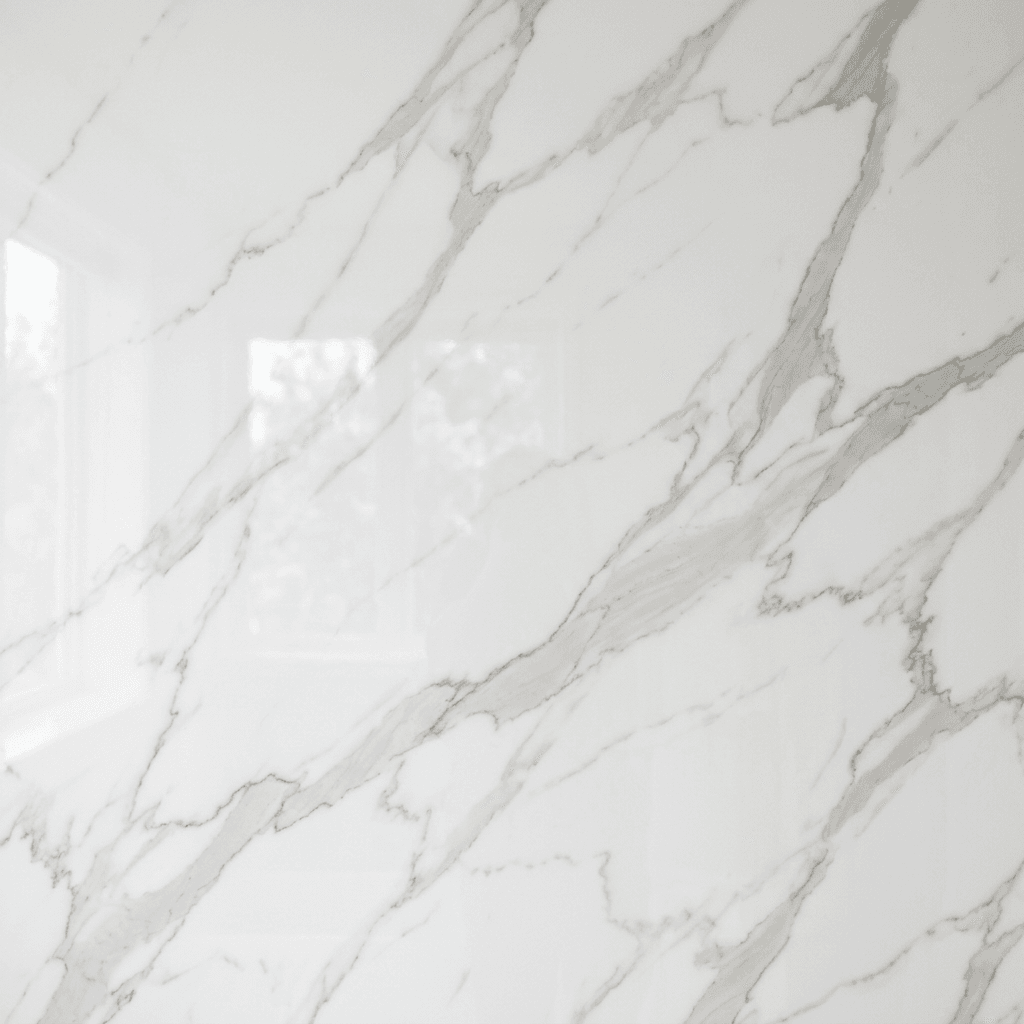
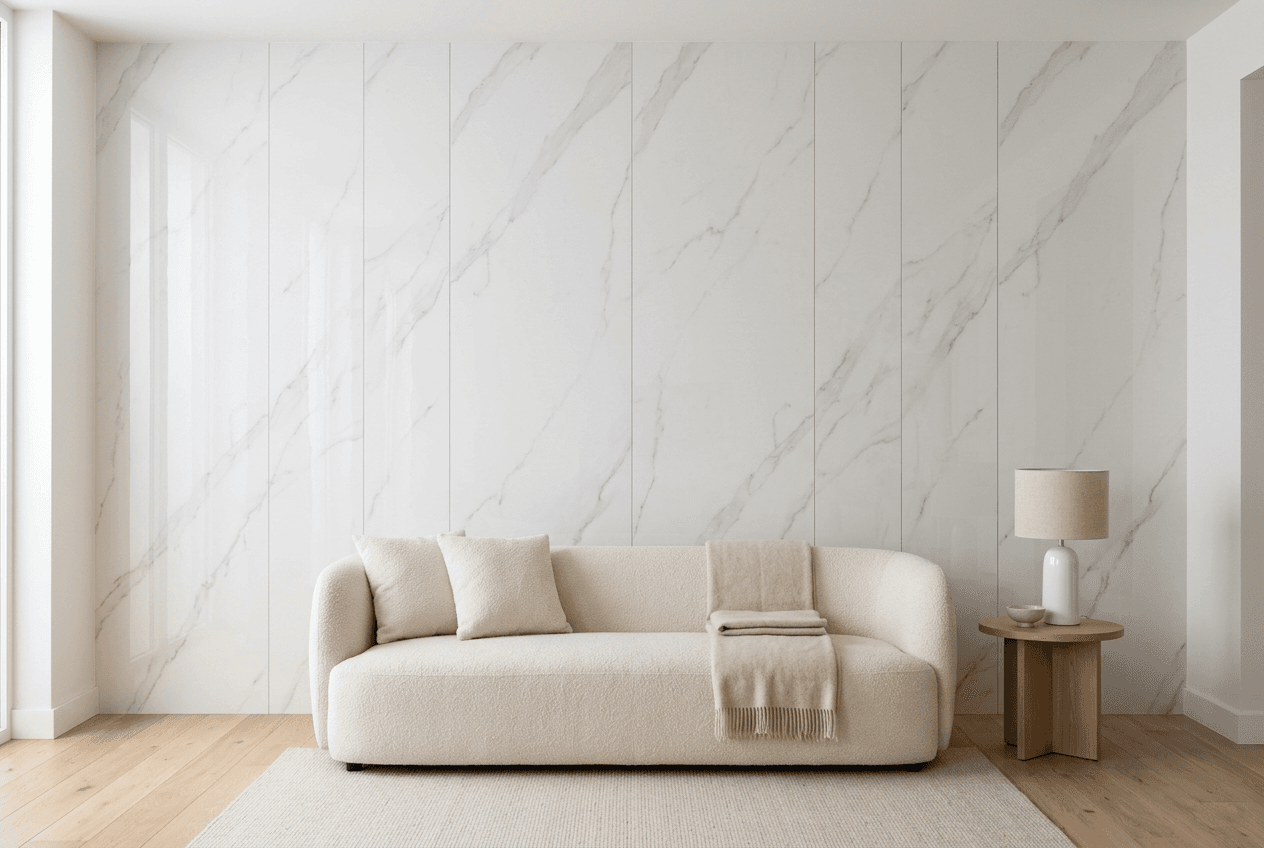
Our UV marble sheet in White gold is PVC with a UV gloss coat, 1220 × 2900 mm and 3 mm thick, with white and gold veining. It is waterproof and wipes clean with a damp cloth.
What do the different sheet names mean?
Shops use the names loosely. UV sheet, UV marble sheet, PVC marble sheet and marble sheet usually describe the same product: a printed PVC sheet with a UV-cured gloss coat. PVC sheet and wall sheet are broader catch-alls. Media wall sheet is a sales name for sheets meant for TV walls. Always ask what the face is.
| Name you will hear | What it usually is | Formats listed |
|---|---|---|
| UV sheet, UV marble sheet | A PVC sheet with a printed face under a UV-cured high-gloss coat | 1220 × 2900 mm (4 × 9.6 ft), 3 mm; self-adhesive versions at 4 × 10 ft |
| PVC marble sheet | Usually the same product as a UV marble sheet | As above |
| Marble sheet | In a wall shop, a printed PVC sheet, not stone | As above |
| PVC sheet | The broadest name: any PVC sheet, plain or printed, with or without a UV coat | Varies; ask for the size, thickness and face |
| Wall sheet | A catch-all for large decorative sheets: UV, PVC, charcoal and onyx | Varies |
| Media wall sheet | A sheet sold for TV walls, usually a UV or marble sheet | 4 × 10 ft |
| Bamboo charcoal sheet | A composite sheet sold under the charcoal name, with a decorative face | About 4 × 9.6 ft |
| Backlit onyx sheet | A translucent sheet that glows when lit from behind | 4 × 8 ft, 5 to 6 mm |
We supply and fit the UV marble sheet in White gold, listed with our other PVC wall panels, and we source bamboo charcoal sheets and backlit onyx sheets on request.
What size are wall sheets?
The common UV marble sheet is 1220 × 2900 mm, sold as 4 × 9.6 ft, and 3 mm thick. That is the size of our White gold sheet. Self-adhesive versions are also sold at 4 × 10 ft. One 1220 × 2900 mm sheet covers about 3.54 m², or 38 sq ft, and covers most room heights in one piece.
Because 1,220 mm is 4 ft to within a millimetre, walls measured in feet divide neatly. An 8 ft wall takes 2 sheets across, a 12 ft wall 3 and a 16 ft wall 4. A 10 ft wall also takes 3, with half a sheet to spare, so the cuts on that wall are worth planning.
Height works the same way. A 9 ft wall is 2,743 mm, so a 2,900 mm sheet covers it with about 157 mm to trim. A 10 ft wall is 3,048 mm, about 148 mm taller than the sheet, and a skirting or top trim usually finishes that gap. A 4 × 10 ft sheet covers a 10 ft wall in one piece, which is where the longer size helps. Our UV marble sheet guide has a full table of sheets across common wall widths.
Are self-adhesive wall sheets a good idea?
They can work on a flat, sound, well-painted wall, but the adhesive only holds as well as the paint beneath it. A large 4 × 10 ft sheet with a sticky back is hard to position, and any trapped air or grit shows as a bump in the gloss. On older or patchy walls, that risk grows.
The appeal is speed: no separate adhesive and fewer tools. The catch is that the wall becomes the weak point. Chalky paint, damp patches and old distemper all let a self-adhesive sheet lift at the edges, and gloss makes even a small lift easy to see. We bond our sheets to a sound, dry wall, so the finish depends on the wall rather than on the paint.
How are wall sheets different from wall panels?
A sheet is wide and thin, so a wall has few joints and a smooth, flat face. A panel is a narrow, thicker board, such as our 160 mm wide, 24 mm thick fluted WPC, so a wall has many joints hidden in its profile, plus real depth and shadow. Sheets show the wall underneath; panels hide more of it.
| Point | UV marble sheet | Fluted or slatted WPC panel |
|---|---|---|
| Format | 1220 × 2900 mm, 3 mm thick | 160, 170 or 195 mm wide, 2.9 m long; 24 mm (160 series) or 14 mm (195 series) |
| Joints | A few, and each one shows on gloss | Many, hidden in the profile |
| Surface | Flat, high-gloss print | Real depth and shadow lines |
| Wall it needs | Flat, sound and dry | Dry and sound; forgiving of small bumps |
| Knocks | A hard, sharp knock can mark the gloss | A rigid board that takes knocks better |
| Switches and sockets | Adds little depth, so plates sit much as before | A 24 mm board stands proud, so each needs a planned cut-out and finish |
| Cleaning | Wipes clean with a damp cloth | A soft brush along the grooves, then a damp cloth |
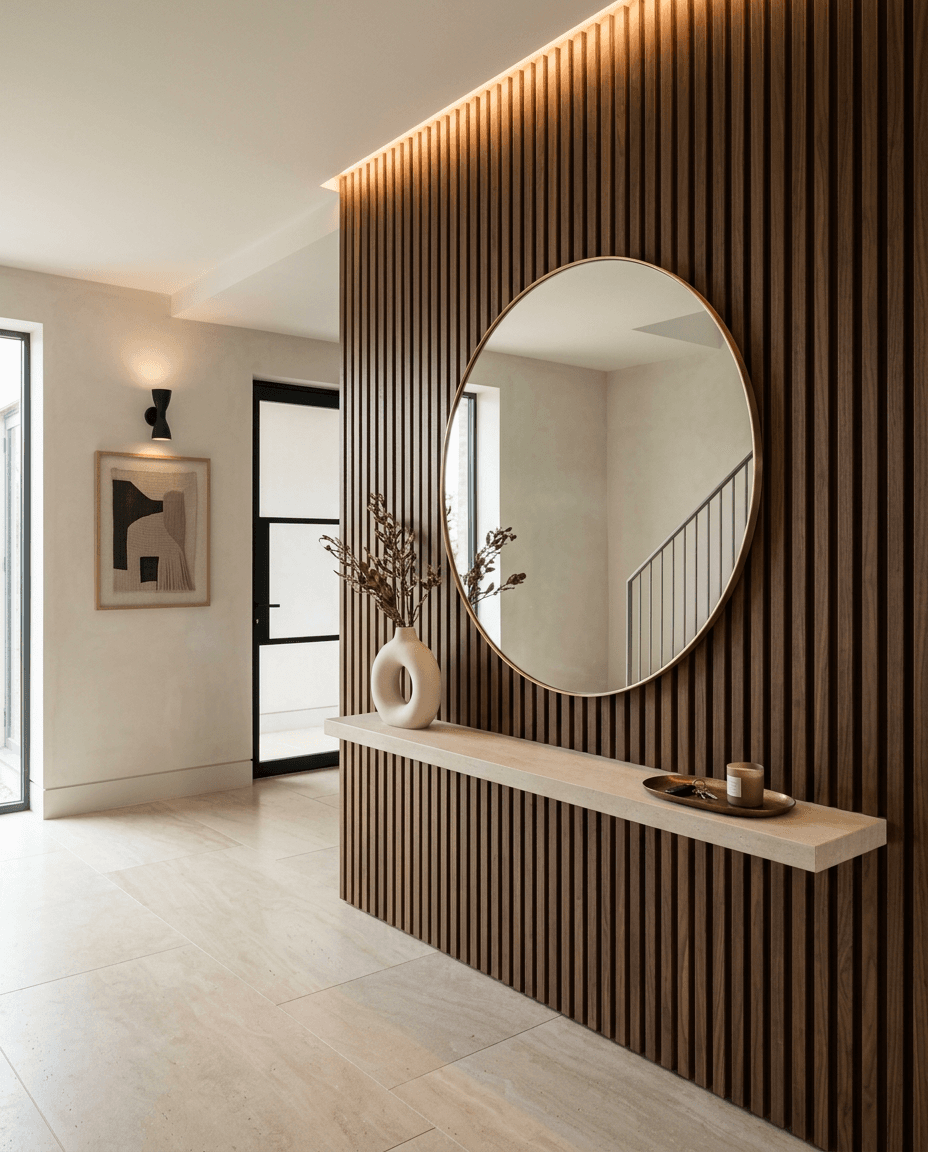
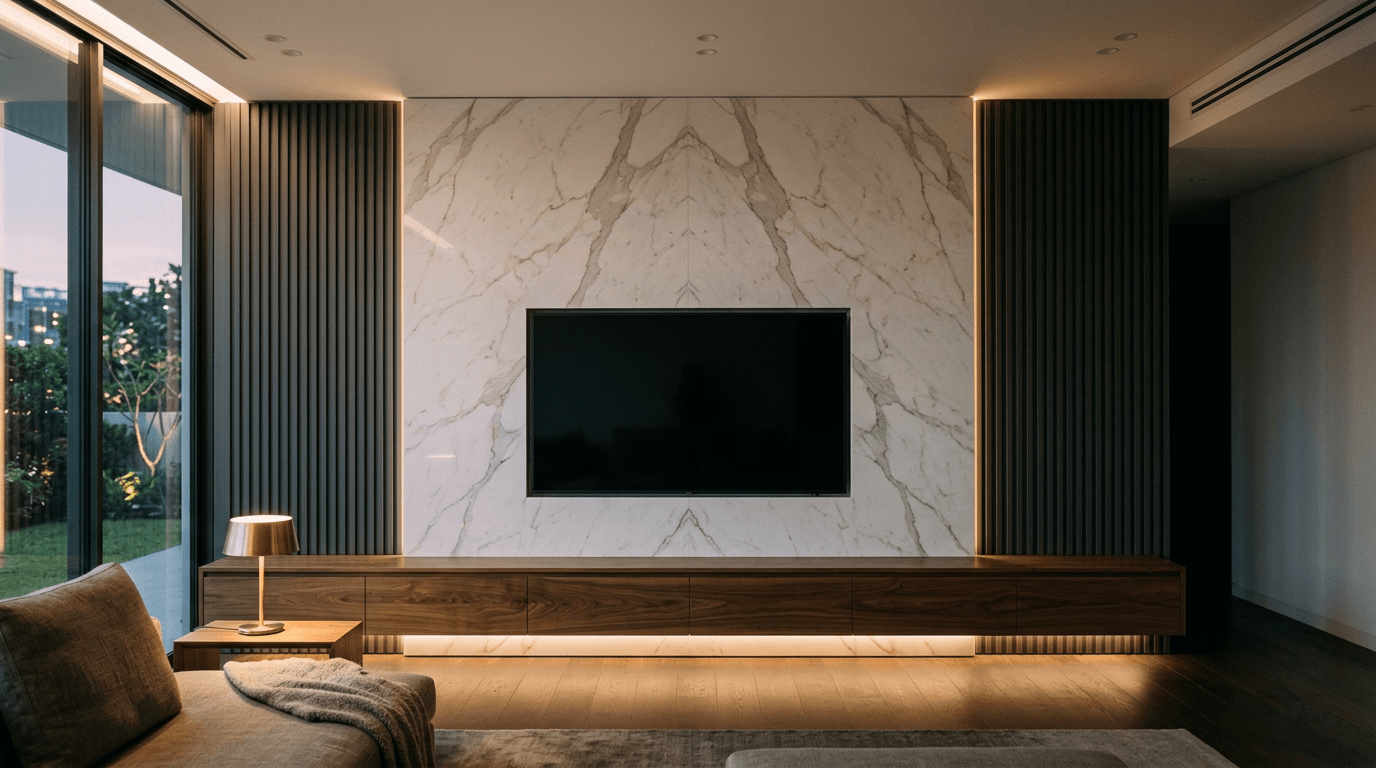
Many walls use both: a sheet where you want calm gloss and panels either side for texture. That is the classic media wall, and our WPC wall panels are made to sit beside a sheet at a trim.
Which way should the veining run?
On most walls, the way it is printed. Sheets go up vertically, one per strip of wall from floor to ceiling, so the veins run as designed. Turning sheets on their side adds horizontal joints across the wall. What you do choose is the order of the sheets, which decides how the veins flow from one sheet to the next.
Bold, diagonal veining gives a wall movement and suits a feature wall seen across a large lounge. Finer, quieter veining tends to suit a wall you look at for hours, such as the TV wall, where a busy pattern competes with the screen.
The print repeats from sheet to sheet. Lay the sheets out on the floor before any go up and look at them together. Where the design allows, turning alternate sheets end for end changes which part of the pattern sits beside which, and stops two identical patches landing side by side.
What is book-matching, and can you do it with sheets?
Book-matching places two mirror-image pieces side by side, so the veining opens out from the joint like the pages of a book. With real stone it comes from slicing one block. With printed sheets it only works if the design is made as mirror-image pairs, because flipping a standard sheet over just shows its back.
Some sheet designs in the market are sold as matched pairs for exactly this. A standard sheet carries the same print every time, so it can’t be book-matched, and it is worth asking before you plan a wall around the effect. If a matched centre is what you want, say so when you ask for a quote, and we will tell you what is available.
Where should the joints and trims go?
Put joints where a break looks planned: behind the TV, on the centre line, or where the sheet meets another material at a trim. Split any cut sheet evenly between both ends of the wall, so you never end up with a thin strip at one side. Every exposed edge, outside corner and top line needs a trim.
On a 10 ft wall, for example, two full sheets and a 608 mm strip at one end looks lopsided. A full sheet in the middle with a 914 mm piece either side looks planned, and both layouts use three sheets.
Gloss also shows any step at a joint. If the wall dips or bulges there, one sheet edge sits proud of the other and the reflection breaks. So the flatness of the wall matters most along the joint lines, and that is where a fitter checks first.
Trims cover the cut 3 mm edge, which otherwise looks raw. You need them at outside corners, where the sheets stop at a door or window frame, along the ceiling and floor, and where marble meets fluted panels. They are usually chosen to match the sheet, or as a thin contrasting line such as a metal-look strip. Whichever you choose, use the same trim all the way round.
How do you clean and look after a wall sheet?
Wipe it with a soft, damp cloth, with a little mild soap for grease, and dry it with a microfibre cloth so the gloss doesn’t spot. Never use scouring powder, steel wool, abrasive pads, thinner or acetone, which dull or scratch the coat. Plan TV brackets and shelves before the sheets go up.
Many sheets arrive with a thin protective film on the face. It should stay on while the wall is fitted and come off last, once the trims are in, so the gloss isn’t scratched during the work.
A quick test for an older wall: hold a phone torch flat against the wall at night and shine it along the surface. Every wave and ridge it shows will show through a gloss sheet too.
Where do wall sheets work, and where don’t they?
Sheets suit media walls, feature walls, and the walls around kitchen counters and washroom vanities, where a waterproof, wipe-clean surface earns its place. They are the wrong choice on uneven, damp or heavily knocked walls, and right behind a cooking flame, because PVC is a plastic and the gloss shows every flaw beneath.
- Media walls: a marble centre behind the TV with fluted WPC either side, as in our media wall design guide and media wall ideas.
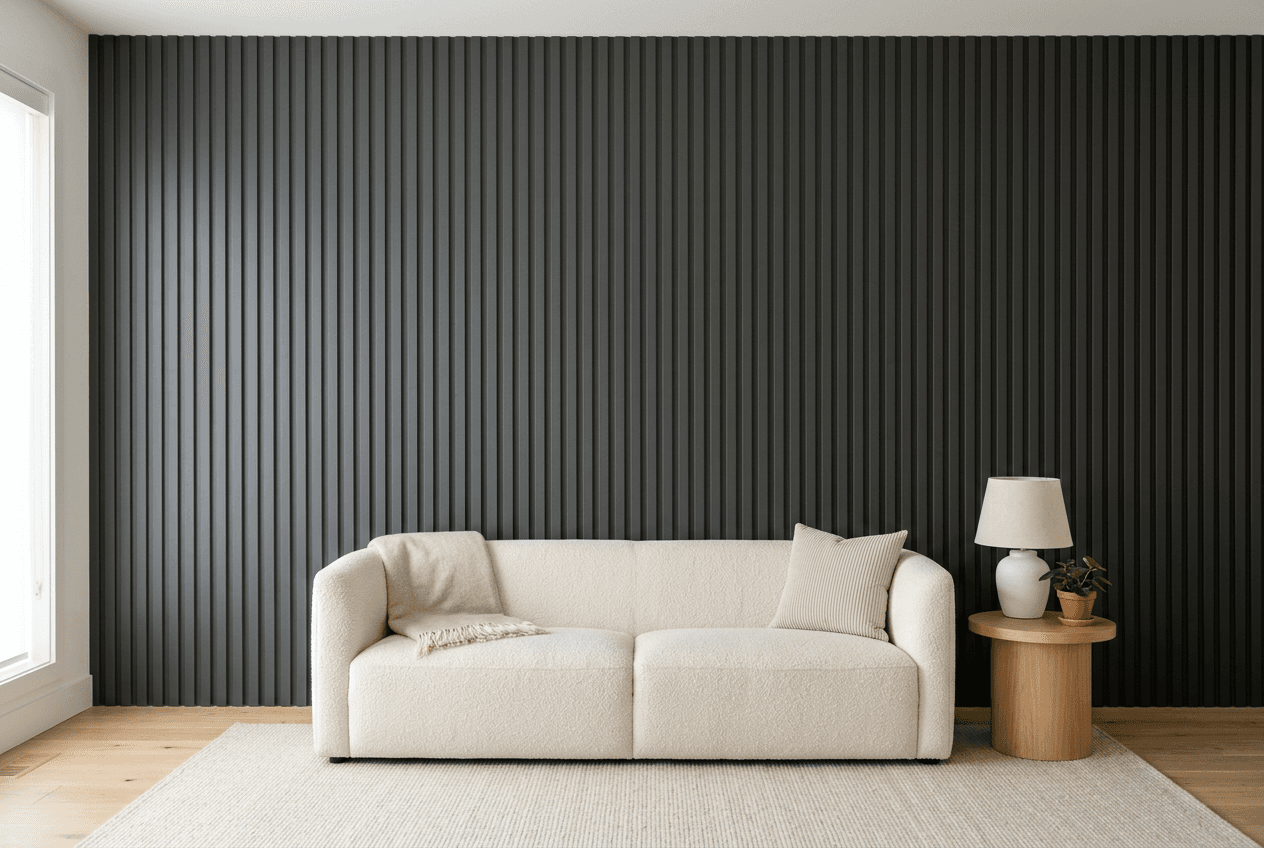
- Feature walls: a full wall of marble where you want brightness and reflected light, as in the lounge above.
- Kitchens and washrooms: around a sink, a counter or a vanity, away from direct flame.
- Not on damp walls: a waterproof sheet seals moisture in. Read wall panels on damp walls before covering seepage with anything.
interiors.pk supplies and fits the White gold UV marble sheet across Islamabad, on its own or beside fluted WPC. You can see it with the rest of our UV marble sheets.
People also ask
What is the size of a wall sheet?
The common UV marble sheet is 1220 × 2900 mm, sold as 4 × 9.6 ft, and 3 mm thick, which is the size of our White gold sheet. Self-adhesive versions are also sold at 4 × 10 ft. One 1220 × 2900 mm sheet covers about 38 sq ft.
What is the difference between a UV sheet and a PVC sheet?
A UV sheet is a PVC sheet with a printed face sealed under a UV-cured high-gloss coat. PVC sheet is a broader name that can mean any PVC sheet, plain or printed, with or without that coat. Ask what the face is before comparing two.
Are wall sheets waterproof?
UV marble sheets are waterproof and wipe clean, which is why they suit kitchen and washroom walls. That describes the sheet, not the wall: a sheet on a damp wall seals the moisture in. Fix any seepage and let the wall dry first.
Can a marble sheet go behind a stove?
Not right behind the flame. A UV marble sheet is PVC, a plastic, so keep it clear of direct flame and the hottest area behind the cooking range. It suits the walls around the sink and counters, where it wipes clean.
Why do wall sheet prices vary so much in Pakistan?
Because “wall sheet” covers different products, sizes, thicknesses and faces, and some prices are for the sheet alone while others include trims, preparation and fitting. Compare the same sheet and the same work. We don’t list prices: send a photo of your wall and its rough size for a written quote.
About this guide
Written by the interiors.pk studio team, based on the products we supply and install. Sizes and specs are from our current range. Last updated .